
Opis
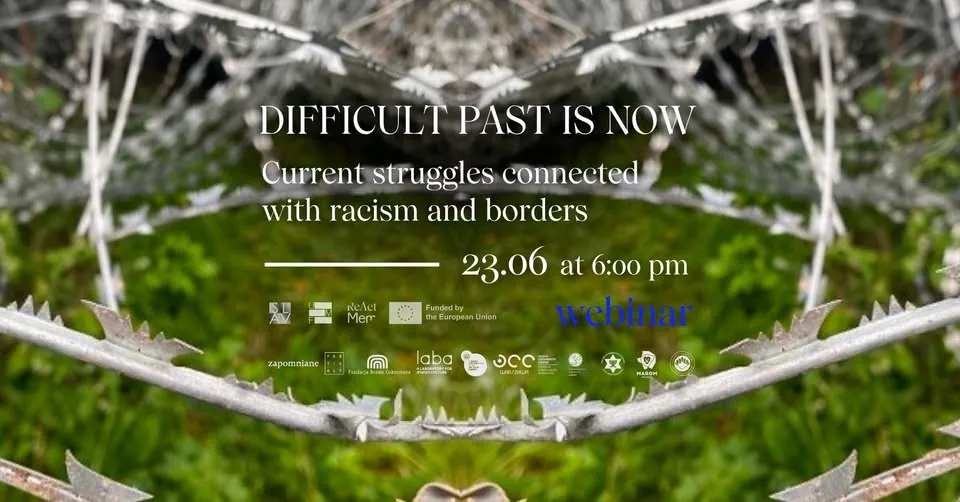
June, 23rd 2026 (Tuesday) | 6 pm -7.30 pm Language: English Please register beforehand: https://forms.gle/rn8NbnEM9v8ibyAcA Zoom link: https://zoom.us/j/97745569596 What do we mean when we speak about the past? Which pasts are remembered, and whose responsibility is it to keep memory alive? Why is the work of remembrance necessary, and what do we gain from acknowledging difficult histories? Most importantly, how does the difficult past become the present, when the refusal to recognise and honour past injustices continues to trouble our societies today? The difficult past is never singular. It can be understood and experienced in myriad ways. In this webinar, we aim to shed light on the histories of communities that have been minoritised, marginalised, and rendered invisible through the mechanisms of the state authorities, dominant societies, and centres of power that continuously rewrite history in ways that further silence those positioned as subaltern. Bringing together speakers working on ongoing crises, and whose work engages with various forms of memory activism, this webinar will explore how the immediate acts of remembrance challenge erasure and create spaces for justice, solidarity, and visibility. The contributions will address current struggles connected with both racialisation and borders. We will have a closer look on how the difficult past materialises in the present and on efforts to reshape the presence to make space for those silenced voices and narratives. Our main scope of interest this time will be on how research, activism, and art can shape the memory of present forms of violence - themes which are at the core of our ongoing EU-funded ReActMem project, soon to be concluded with its final result, the Rescue Memory Handbook. During the webinar we will concentrate on two main case studies: 1) Romani histories and contemporary presence, as well as forms of memory activism that connect past experiences of war, displacement, and genocide with the ongoing war in Ukraine, 2) memory, grief and commemorative activism on irregularized passages to the European Union of those who have died seeking asylum in Europe and the wider world. The contributions come from: > Artur Ivanenko TENET organisation, and Tetiana Storozhko, TENET organisation, Stuttgard/Lviv > Elżbieta Mirga-Wójtowicz, Jaw Dikh Foundation, Centre of Migration Research, University of Warsaw, Warsaw/Krakow > Natalia Judzińska, Institute for Slavic Studies, Polish Academy of Sciences, Researchers on the Border (BBnG), Warsaw > Marijana Hameršak, Institute of Ethnology and Folklore Research, Zagreb > Selma Banich, independent artist and activist, Zagreb Moderation: Kamila Fiałkowska, Centre of Migration Research, University of Warsaw, Researchers on the Border (BBnG), Warsaw Organizers: The Institute of Slavic Studies, Polish Academy of Sciences, Researchers on the Border and the Urban Memory Foundation. -------------- Photo: Razor wire at the Polish-Belarusian border, 2025. Kamila Fiałkowska | Graphic: Arek Fochtman This event is organized as part of the "ReActMem: Rescue Memory - Activism, Arts and Public Remembrance" project, funded by the EU (CERV program). https://reactmem.difficultheritage.eu/
June, 23rd 2026 (Tuesday) | 6 pm -7.30 pm Language: English Please register beforehand: https://forms.gle/rn8NbnEM9v8ibyAcA Zoom link: https://zoom.us/j/97745569596 What do we mean when we speak about the past? Which pasts are remembered, and whose responsibility is it to keep memory alive? Why is the work of remembrance necessary, and what do we gain from acknowledging difficult histories? Most importantly, how does the difficult past become the present, when the refusal to recognise and honour past injustices continues to trouble our societies today? The difficult past is never singular. It can be understood and experienced in myriad ways. In this webinar, we aim to shed light on the histories of communities that have been minoritised, marginalised, and rendered invisible through the mechanisms of the state authorities, dominant societies, and centres of power that continuously rewrite history in ways that further silence those positioned as subaltern. Bringing together speake...
Terminy
23 Czerwca 2026, Wtorek
16:00 - 17:30
Organizatorzy
F
UMF działa na rzecz przybliżenia pamięci o przedwojennej społeczności żydowskiej Wrocławia. Zależy nam, aby dziedzictwo Żydów z Breslau stało się bliskie sercom i umysłom wrocławian i nie tylko.
I
Witamy na stronie Instytutu Slawistyki PAN!
B
Międzyuczelniana grupa badawcza, której celem jest jak najszersze zebranie danych związanych z kryzysem humanitarnym na północno-wschodniej granicy Unii Europejskiej oraz prowadzenie działań z zakresu edukacji obywatelskiej.