
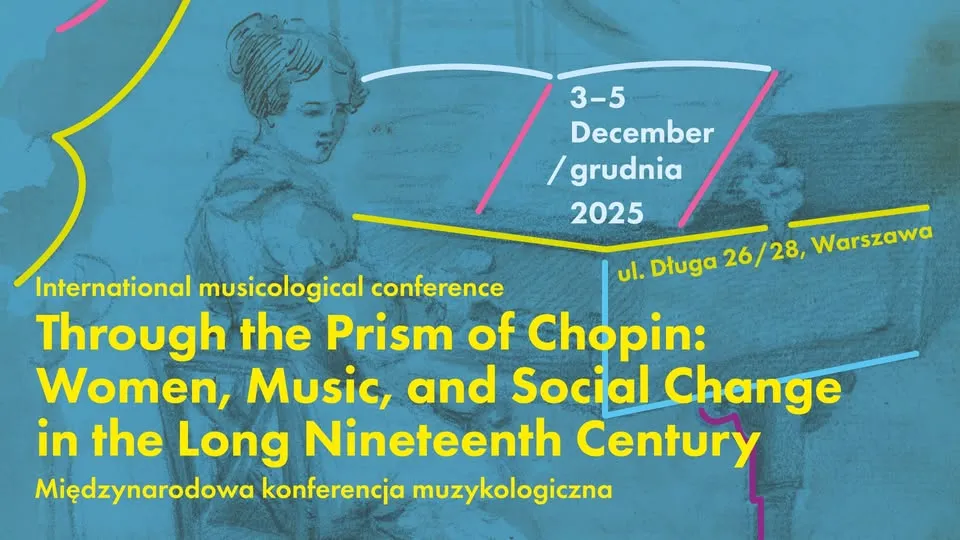
Międzynarodowa konferencja muzykologiczna „Through the Prism of Chopin"
Miejsce
Instytut Sztuki PAN
Instytut Sztuki Pan, 00-238 Śródmieście, Polska
Cena
Bezpłatne
Opis
Through the Prism of Chopin: Women, Music, and Social Change in the Long Nineteenth Century Międzynarodowa konferencja muzykologiczna Zapraszamy w dn. 3-5 grudnia do Instytutu Sztuki Polskiej Akademii Nauk na ul. Długiej 26/28 w Warszawie WSTĘP WOLNY ____ for English scroll down 👇 ____ PL: Przemiany społeczne zachodzące w XIX wieku obejmowały między innymi emancypację - zarówno klasową, skutkującą osiągnięciem niezależności, a z czasem dominującej roli przez mieszczaństwo, jak i płciową. Kobiety we wszystkich dziedzinach życia, w tym w dziedzinie sztuki, dotychczas działające niemal wyłącznie w środowisku domowym, zaczęły być aktywne także w sferze publicznej - w zakresie muzyki przede wszystkim jako wykonawczynie, ale także kompozytorki czy pedagożki w powstających wówczas coraz liczniej konserwatoriach muzycznych. Mierzyły się niejednokrotnie z ugruntowanymi przez stulecia przekonaniami o wyższości męskiej twórczości nad kobiecą - w 1836 roku Robert Schumann, sam wszak związany z wybitną pianistką i kompozytorką Clarą z domu Wieck - pisał o zbiorze etiud Marii Szymanowskiej: „Należy wysoko oceniać już same przypadki, gdy kobiety grają etiudy, tym bardziej zaś takie, gdy je piszą; do tego te [konkretne etiudy] są naprawdę dobre i kształcące, mianowicie [służąc] do nauki figur, ornamentów, rytmów itd. Znać [w nich] generalnie niepewną kobietę, szczególnie w kwestii formy i harmonii, jak również muzyczne uczucie, które chciałoby wyrazić jeszcze więcej, gdyby mogło. Inwencję i charakter określimy jednakowoż jako najbardziej znaczące spośród wszystkiego, co dotychczas powstało w muzycznym świecie kobiet" (pobłażliwe podejście Schumanna należało do najbardziej przychylnych kobietom-kompozytorkom, większość męskich krytyków czy autorów odmawiało im bowiem zupełnie zdolności do tworzenia). Współcześnie wartość twórczości takich autorek, jak Szymanowska, Clara Wieck-Schumann czy Fanny Mendelssohn-Hensel - by wymienić tylko najpowszechniej znane nazwiska - nie budzi żadnych wątpliwości. Jednocześnie zachowywały znaczenie działania kobiet w kręgach prywatnych i kameralnych - dzięki właścicielkom albumów dysponujemy dziś wielkiej wagi dziedzictwem materialnym, bezsprzeczna była i jest także kulturotwórcza i opiniotwórcza funkcja salonów prowadzonych przez arystokrację lub przedstawicielki mieszczaństwa („zaraz lepiej grasz, jeżeli cię Xżna Vaudémont protegowała" - pisał Chopin zaraz po przybyciu do Paryża). Celem naszej konferencji jest skupienie się na XIX-wiecznej twórczości i wykonawstwie kobiet, roli prowadzonych przez nie albumów oraz salonów zwłaszcza przez pryzmat dorobku i biografii Fryderyka Chopina - w tym na kompozytorkach, pianistkach, śpiewaczkach powiązanych z nim bezpośrednio lub pośrednio. Szczególne miejsce poza dziedziną muzyki rezerwujemy dla George Sand - wciąż postrzeganej, przede wszystkim w środowisku muzykologicznym, głównie jako partnerka życiowa Chopina, z pominięciem jej znaczącej twórczości literackiej bądź istotnych przekonań polityczno-społecznych. Międzynarodowa konferencja muzykologiczna „Through the Prism of Chopin: Women, Music, and Social Change in the Long Nineteenth Century" | 3-5 grudnia 2025, Instytut Sztuki PAN PROGRAM: 📆 3 grudnia 10.00-11.00 wykład inauguracyjny Henrike Rost, Writing women's history with nineteenth-century friendship albums 11.00-12.00 Fernanda Vera Malhue, The musical and cultural imaginary in Isidora Zegers's 'album amicorum' Magdalena Oliferko-Storck, The Schumann-Album as an anthropological study of the culture of gift exchange 12.00-12.30 przerwa kawowa 12.30-14.00 Christine Elizabeth Wisch, 'A Philharmonic Woman': negotiating music, gender, and performance in mid-nineteenth-century Spanish salons and associations Anja Bunzel, Nineteenth-century salon culture and hidden women's autobiography in Johanna Kinkel's 'Friedrich Chopin als Komponist' Dylan Henderson, 'A fragrance of the freshest flowers': Chopin, Pleyel and the soprani sfogati 14.00-15.00 przerwa lunchowa 15.00-16.00 Virginia Sánchez Rodríguez, Marie Mennessier-Nodier, a female amateur musician in the age of Chopin Paulina Andrade Schnettler, 'A profession that protects them from poverty and corruption…': women, musical work and authorial identity in 19th-century Chile 📆 4 grudnia 9.00-10.00 wykład plenarny Katarzyna Nadana-Sokołowska, Female singers in George Sand's novels 10.00-11.00 Anne Teresa Marcoline, Attentive listening, care, and social change in George Sand's musical fiction Joe Davies, Jane Wilhelmina Stirling as 'Chopin's widow' 11.00-11.30 przerwa kawowa 11.30-13.00 Cristina Pascu, Marcelina Czartoryska and the afterlife of Chopin's style: informal mediation, gendered authority, and the formation of a performance tradition Laura Stokes, Jenny Lind and Otto Goldschmidt's transcriptions of Chopin's mazurkas for the concert hall Laure Schnapper, Berthe Marx-Goldschmidt (1857-1925), first female pianist to perform Chopin's complete Preludes and Etudes 13.00-14.00 przerwa lunchowa 14.00-15.00 Karolina Kolinek-Siechowicz, Against the excesses of Romanticism: Chopin's legacy as a source of Wanda Landowska's search for authenticity Tomasz Fatalski, 'She is one of the best pianists we have ever heard': Jadwiga Brzowska-Méjan and her musical career 15.00-15.30 przerwa kawowa 15.30-17.00 Jérôme Dorival, Hélène de Montgeroult Renata Bittencourt de Assis Pereira, Marie Jaëll and Camille Erard: a chronicle of two Alsatian women in the Parisian musical scenario in the 19th century Katarzyna Hajduk, In search of the identity of sound and emotion - Marie Jaëll's innovative method 📆 5 grudnia 9.00-10.00 wykład plenarny Candace Bailey, Chopin as signifier of social change in the Southern United States 10.00-11.30 Dorothea Hilzinger & Christine Hoppe, Staging gender in 19th-century string quartets: exploring female composers and performers Seonhwa Lee, Emilie Mayer's cello sonatas: creativity and reception in 19th-century Berlin Katarzyna Bartos, Sounds without taboo - analysis and interpretation of selected violin sonatas by 19th-century female composers 11.30-12.00 przerwa kawowa 12.00-13.00 Floris Meens, Chopin in the Netherlands during the long nineteenth century Kwen-Yin Li, Effeminate Chopin in the eye of effeminate Orient 13.00-14.00 przerwa lunchowa 14.00-15.30 Karol Rzepecki, Musical activity of women in 19th-century Lublin - a source study Katarzyna Naliwajek, Long Nineteenth Century, Chopin's tradition and its forced discontinuation - Jewish female pianist victims of Nazism Tiziana Palandrani, 'Votre délicieuse surprise': an unpublished letter to Chopin EN: International musicological conference 'Through the Prism of Chopin: Women, Music, and Social Change in the Long Nineteenth Century' (2025) 3-5 December, Institute of Art of the Polish Academy of Sciences (Instytut Sztuki Polskiej Akademii Nauk) at 26/28 Długa Street in Warsaw The social changes taking place in the nineteenth century included emancipation in both social class, resulting in the independence and, with time, dominant role of the bourgeoisie, and gender. Women in all areas of life, including the arts, had hitherto been confined almost exclusively to the home environment, but now became active in the public sphere as well. In the field of music, it was primarily as performers, but also as composers or teachers at the growing number of music conservatories. Women often faced convictions - hardened over centuries - about the superiority of male creativity over female creativity. In 1836 Robert Schumann, himself associated with the outstanding pianist and composer Clara (née Wieck), wrote about a collection of etudes by Maria Szymanowska: 'If we should praise women highly, when they only play études, we ought to do even more when they write them. However, these are really good and improving, especially for studying figuration, ornaments, and rhythm. If we detect the uncertain woman in form and harmony, we find also the woman full of feeling, who has much more to say, if she only knew how. In character and invention these present the most remarkable qualities, for a woman composer, that we have met with' (Schumann's indulgent approach was among the most favourable to women composers; most male critics and authors completely denied their ability to create). Today, the value of the work of such composers as Szymanowska, Clara Schumann and Fanny Mendelssohn-Hensel - to mention but the most widely known names - raises no doubts. At the same time, women's activities in private circles maintained their significance: thanks to the owners of albums, we now have a material heritage of great importance, and there is no denying the influence on culture and opinion exerted by salons among the aristocracy or the bourgeoisie ('you immediately play better if Duchess Vaudémont made you her protégé' - wrote Chopin right after arriving in Paris). The aim of our conference is to focus on women in the nineteenth century as composers and performers and on the role of the albums they kept and the salons over which they presided, especially through the prism of Fryderyk Chopin's achievements and biography, including female composers, pianists and singers directly or indirectly associated with him. A special place outside the field of music is reserved for George Sand - still perceived, primarily in the musicological community, mainly as Chopin's life partner, with no account taken of her significant literary output and political and social beliefs. International Musicological Conference "Through the Prism of Chopin: Women, Music, and Social Change in the Long Nineteenth Century" | 3-5 December 2025, Institute of Art, Polish Academy of Sciences PROGRAM: 📆 3 December 10.00-11.00 Keynote lecture Henrike Rost, Writing women's history with nineteenth-century friendship albums 11.00-12.00 Fernanda Vera Malhue, The musical and cultural imaginary in Isidora Zegers's 'album amicorum' Magdalena Oliferko-Storck, The Schumann-Album as an anthropological study of the culture of gift exchange 12.00-12.30 coffee break 12.30-14.00 Christine Elizabeth Wisch, 'A Philharmonic Woman': negotiating music, gender, and performance in mid-nineteenth-century Spanish salons and associations Anja Bunzel, Nineteenth-century salon culture and hidden women's autobiography in Johanna Kinkel's 'Friedrich Chopin als Komponist' Dylan Henderson, 'A fragrance of the freshest flowers': Chopin, Pleyel and the soprani sfogati 14.00-15.00 lunch break 15.00-16.00 Virginia Sánchez Rodríguez, Marie Mennessier-Nodier, a female amateur musician in the age of Chopin Paulina Andrade Schnettler, 'A profession that protects them from poverty and corruption…': women, musical work and authorial identity in 19th-century Chile 📆 4 December 9.00-10.00 Keynote lecture Katarzyna Nadana-Sokołowska, Female singers in George Sand's novels 10.00-11.00 Anne Teresa Marcoline, Attentive listening, care, and social change in George Sand's musical fiction Joe Davies, Jane Wilhelmina Stirling as 'Chopin's widow' 11.00-11.30 coffee break 11.30-13.00 Cristina Pascu, Marcelina Czartoryska and the afterlife of Chopin's style: informal mediation, gendered authority, and the formation of a performance tradition Laura Stokes, Jenny Lind and Otto Goldschmidt's transcriptions of Chopin's mazurkas for the concert hall Laure Schnapper, Berthe Marx-Goldschmidt (1857-1925), first female pianist to perform Chopin's complete Preludes and Etudes 13.00-14.00 lunch break 14.00-15.00 Karolina Kolinek-Siechowicz, Against the excesses of Romanticism: Chopin's legacy as a source of Wanda Landowska's search for authenticity Tomasz Fatalski, 'She is one of the best pianists we have ever heard': Jadwiga Brzowska-Méjan and her musical career 15.00-15.30 coffee break 15.30-17.00 Jérôme Dorival, Hélène de Montgeroult Renata Bittencourt de Assis Pereira, Marie Jaëll and Camille Erard: a chronicle of two Alsatian women in the Parisian musical scenario in the 19th century Katarzyna Hajduk, In search of the identity of sound and emotion - Marie Jaëll's innovative method 📆 5 December 9.00-10.00 Keynote lecture Candace Bailey, Chopin as signifier of social change in the Southern United States 10.00-11.30 Dorothea Hilzinger & Christine Hoppe, Staging gender in 19th-century string quartets: exploring female composers and performers Seonhwa Lee, Emilie Mayer's cello sonatas: creativity and reception in 19th-century Berlin Katarzyna Bartos, Sounds without taboo - analysis and interpretation of selected violin sonatas by 19th-century female composers 11.30-12.00 coffee break 12.00-13.00 Floris Meens, Chopin in the Netherlands during the long nineteenth century Kwen-Yin Li, Effeminate Chopin in the eye of effeminate Orient 13.00-14.00 lunch break 14.00-15.30 Karol Rzepecki, Musical activity of women in 19th-century Lublin - a source study Katarzyna Naliwajek, Long Nineteenth Century, Chopin's tradition and its forced discontinuation - Jewish female pianist victims of Nazism Tiziana Palandrani, 'Votre délicieuse surprise': an unpublished letter to Chopin
Through the Prism of Chopin: Women, Music, and Social Change in the Long Nineteenth Century Międzynarodowa konferencja muzykologiczna Zapraszamy w dn. 3-5 grudnia do Instytutu Sztuki Polskiej Akademii Nauk na ul. Długiej 26/28 w Warszawie WSTĘP WOLNY ____ for English scroll down 👇 ____ PL: Przemiany społeczne zachodzące w XIX wieku obejmowały między innymi emancypację - zarówno klasową, skutkującą osiągnięciem niezależności, a z czasem dominującej roli przez mieszczaństwo, jak i płciową. Kobiety we wszystkich dziedzinach życia, w tym w dziedzinie sztuki, dotychczas działające niemal wyłącznie w środowisku domowym, zaczęły być aktywne także w sferze publicznej - w zakresie muzyki przede wszystkim jako wykonawczynie, ale także kompozytorki czy pedagożki w powstających wówczas coraz liczniej konserwatoriach muzycznych. Mierzyły się niejednokrotnie z ugruntowanymi przez stulecia przekonaniami o wyższości męskiej twórczości nad kobiecą - w 1836 roku Robert Schumann, sam wszak związany...
Terminy
3 Grudnia 2025, Środa
09:00 - 15:00
Organizatorzy
N
Narodowy Instytut Fryderyka Chopina jest największym centrum chopinowskim na świecie, które w pełni i wszechstronnie promuje, chroni, bada i upowszechnia dziedzictwo Fryderyka Chopina.
I
Interdyscyplinarna placówka naukowa zajmująca się badaniami i dokumentacją różnych dziedzin sztuki i kultury. Zatrudnia specjalistów z zakresu historii sztuki, muzykologii, teatrologii, filmoznawstwa i antropologii kultury.